When you pair Seoraksan and Odaesan over two days, the order changes the outcome. Odaesan on Day 1, Seoraksan on Day 2 is the stable version. Odaesan's forest paths photograph well even before full colour, while Seoraksan is spectacular if you hit the peak and deflating if you miss it by a week. Putting the volatile half second means Day 1 gives you something either way.

When to go
Peak colour usually falls in a narrow window in mid-to-late October. Weatheri's 2025 forecast put Odaesan around 17 October and Seoraksan around 23 October. Those were that year's forecasts — not long-term averages, and not a projection for 2026 — so check the current year's forecast again before you commit to dates. From mid-November, fire-prevention season can close some trails entirely, which is a harder constraint than colour.
Seoraksan: pick one of three by stamina
- Gwongeumseong cable car — a round trip of about 10 minutes. No advance reservation exists; tickets are sold on site on the day only. Round-trip fares are KRW 16,000 for adults and KRW 12,000 for children, free for children 36 months and under, with discount fares handled separately
- Biseondae — roughly 3 km one way from Sogongwon. Budget two hours round trip plus rest. The reward is the rock face and foliage at the mouth of Cheonbuldong Valley
- Ulsanbawi — about four hours round trip. Past Heundeulbawi the route turns into steep rock and metal staircases, and the difficulty rises sharply
Saturday mornings see the cable car queue build fast, so target a weekday or the first run of a weekend morning. On Ulsanbawi, a windy day raises the perceived difficulty far more than the distance suggests, so check the forecast before setting off. The Biseondae path has slippery and uneven sections in places, which makes proper walking shoes worth the space in your bag.
Odaesan: one of two paths is enough
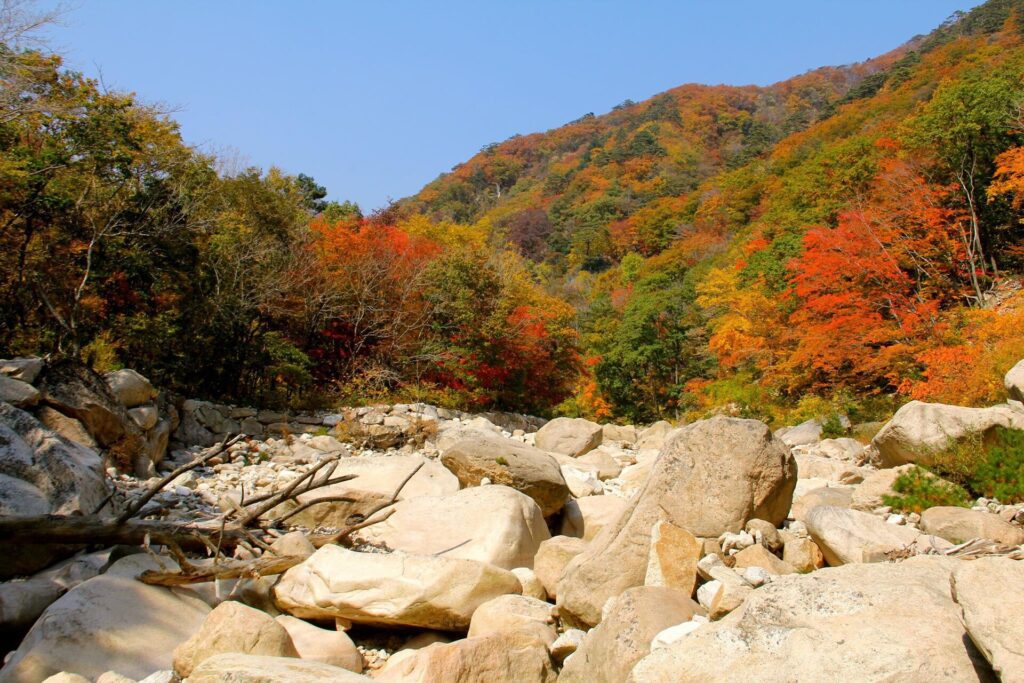
The Woljeongsa fir-tree path runs 1.9 km and takes about an hour according to Pyeongchang's tourism information. It is close to barrier-free, which makes it the right choice with family or with a friend visiting Korea for the first time. The Seonjae trail runs 10.7 km and about four hours from the ticket office to Sangwonsa; counting only the forest section from Woljeongsa to Sangwonsa, it is roughly 9 km.
If you plan to walk Seonjae one way, check the return bus schedule and last departure first, or book a taxi in advance. Do not assume something will be waiting when you arrive. Demand for transport concentrates during foliage season, so leave more slack in the afternoon than the trail time alone would suggest.
"Free" does not mean free
Woljeongsa's cultural property admission fee was abolished in May 2023. Parking is charged separately, and Woljeongsa's own information lists roughly KRW 3,000 to 9,000 depending on vehicle class, with peak and off-peak rates. Odaesan National Park also lists free admission while charging for parking. For lodging, staying in central Sokcho or at a Yangyang beach pension on the first night shortens the Day 2 approach to Seoraksan considerably, which matters when you are trying to reach the cable car before the queue does.
Difficulty, duration and lodging positions for every course are gathered into a single table in the Gangwon foliage road write-up on the WeBring blog.